Tree info
Tree info
Something about the tree has you worried. Ben comes out, has a proper look at it, and tells you straight what is going on.
Most people ring an arborist because something has changed. A crack, a lean, a limb that came down, leaves that are not right for the time of year. The useful question is a simple one: is this tree a problem, and if it is, what is the smallest thing that fixes it?
What Ben looks at
- How the tree is built. The main unions and forks, whether there is included bark trapped in them, and where the weight goes when the wind gets up.
- Defects. Cracks, cavities, decay pockets, old failure points, and damage left behind by bad pruning years ago.
- Deadwood. How much there is, how big it is, and what is sitting underneath it.
- The canopy. Density, dieback, stress growth, leaf colour and size against what that species should look like at this time of year.
- Pests and disease. Elm leaf beetle, borers, fungal brackets, and the signs of rot at the base.
- The ground. Compaction, recent digging, paving, changed soil levels, drainage. This is where most mysteries get solved.
Usually the problem is at ground level
A mature tree that starts thinning out for no obvious reason has very often had something happen to its roots. A build next door. A new driveway. Soil piled over the root zone during landscaping. A trench for a pipe that cut through the wrong side.
The catch is timing. The canopy usually does not show it for a year or two, so by the time anyone notices, nobody connects it to the excavator that was there last spring. Knowing to look down instead of up is most of the job.
Leaning trees
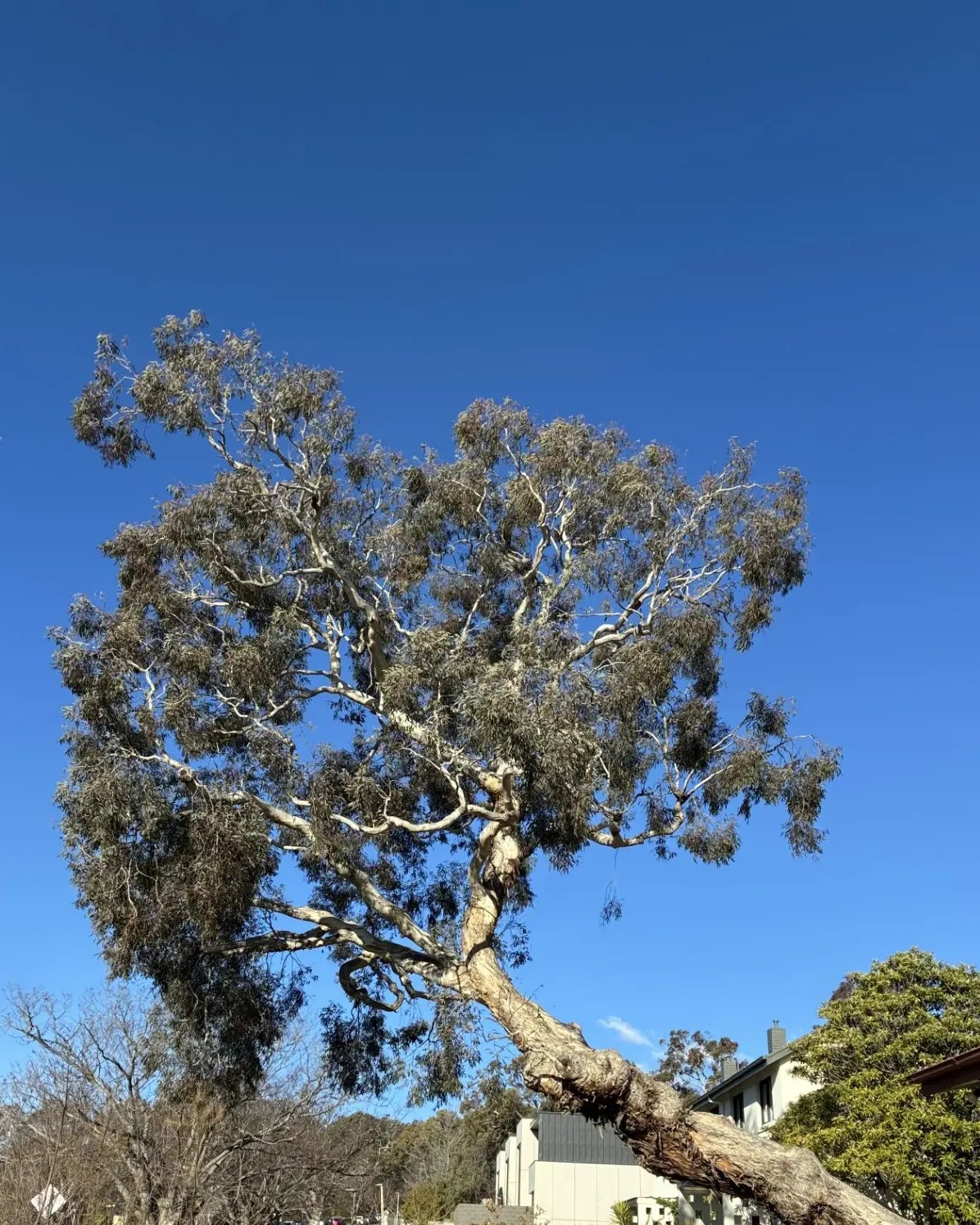
A lean on its own is not a problem. Plenty of trees lean their whole lives and are perfectly sound, particularly if they grew that way reaching for light. What matters is whether the lean is new, whether the soil is cracked or lifting on the opposite side of the trunk, and whether the root plate is moving. Those are the things worth checking.
What tends to go wrong in Canberra
Elm leaf beetle is everywhere in the older suburbs and hammers elm canopies every summer. Most trees cope, but the repeated stress builds deadwood, which is the part that actually matters when it is hanging over a driveway.
Included bark unions in the big 1970s eucalypts. Two stems grown tight together with bark trapped between them and no real wood connection. They split, usually in wind, usually taking half the tree.
Drought stress followed by a wet year. Canberra swings hard between the two, and trees shed limbs on the way through.
Straight answers, including “it is fine”
Sometimes the honest answer is that the tree is healthy, the lean is old and stable, and nothing needs doing. Ben will tell you that when it is true. An arborist who finds expensive work on every tree he looks at is not really looking.
And where something does need doing, it is very often a deadwood clean-out or a reduction rather than a removal.
If your tree needs ACT approval
People tell us the ACT Government site is hard to navigate, so here is the direct link. The form you want is a tree activity application, and it is lodged online through the Urban Forest Management System.
Apply to remove or prune a protected tree
Tree activity applications on the ACT Government site explains what to lodge, or go straight to the Urban Forest Management System to apply. A fee applies, and assessment can take up to 35 working days, so allow about two months if you have a settlement or a build to work around.
The application is the property owner’s to make. Ben will tell you when he thinks you need one, and what he would put on it.
Talk to Ben about it
Give him a call and he will come out and have a look. 0407 573 008 — call or text.
What’s included
What you get when Treetops does the job
- Ben comes and looks at it. In person, on your block, not guessing from a photo.
- Plain English. What is wrong, how serious it is, what he would do about it.
- The ground gets checked too. The most missed cause of a tree going backwards.
- No upselling. If the answer is leave it alone, that is the answer you get.
- Free with a quote. Have a look at the tree and price the work in the one visit.
- Least drastic option first. Pruning beats removal wherever pruning will do.
“I highly recommend this arborist for tree pruning. Treetops trimmed the deadwood in my nearly 60 year old Elm Tree in Torrens and pruned it to help restore it’s shape. Ben was the arborist that led the work (and is the owner) which completely respected the look and structure of my tree. I had an unqualified crew hack through the tree some years ago, and it’s taken a long time for it to recover. So I was really happy and relieved when Ben explained what was done to ensure the old tree’s health. They were efficient and friendly, the cleanup was great and my tree is happy!”
Common questions
My tree is leaning. Is it about to fall over?
Probably not, but it is worth a look. Many trees lean for their whole lives without any issue. The warning signs are a lean that is new, soil cracking or lifting on the opposite side of the trunk, and a root plate that moves. If you are seeing any of those, keep clear of it and give Ben a call.
My tree is dying and I have not done anything to it.
Something has usually happened underground. Compaction from vehicles or a build, soil levels changed over the roots, paving, or roots cut during trenching. The canopy shows it a year or two later, which is why the two rarely get connected.
There are mushrooms growing at the base of my tree.
Worth having looked at. Fungal brackets at the base or on a major limb are the fruiting body of something already well established inside the wood. It does not always mean the tree has to go, but it does mean someone should check how much sound wood is left.
Does it cost anything to have Ben look at it?
Not if he is quoting work at the same time. He comes out, looks at the tree, tells you what he thinks and gives you a price. No charge and no obligation.
Get an honest answer about your tree
Ben quotes every job himself. You get a straight answer, a fixed price and no pressure — whether the answer is remove it, prune it or leave it alone.